AI is becoming a colleague, not a tool
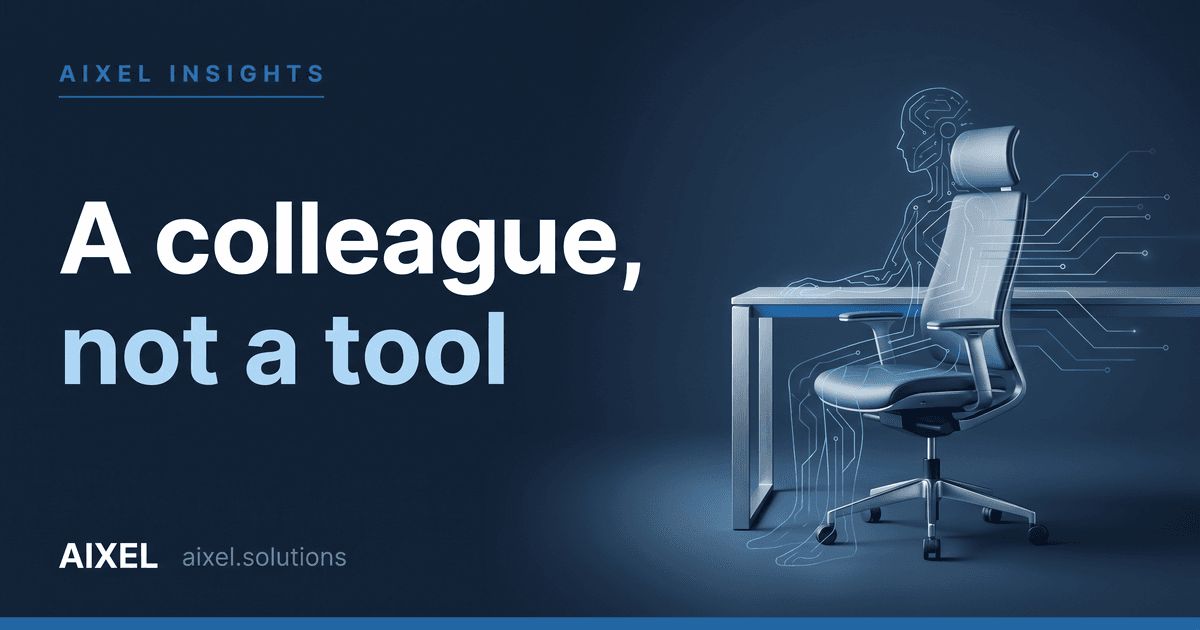
AI just crossed the line from a tool you use to a colleague you work with. That is a management decision, not a model upgrade - and most companies are about to learn it the hard way.
For three years, "AI at work" meant a smarter tool. A better draft, a faster search, a window you open when you need something and close when you are done. Useful, and still just a tool that waits to be used.
That framing is expiring in front of us. The forecasts are loud: Gartner expects at least 15% of day-to-day work decisions to be made autonomously through agentic AI by 2028, up from zero in 2024, and 33% of enterprise software to carry agentic AI, up from under 1%. Deloitte puts a quarter of generative-AI companies on AI agents this year, half by 2027.
Here is the part nobody frames well. The same analysts predicting the surge are also predicting the wreck: Gartner says more than 40% of agentic AI projects will be cancelled by the end of 2027, on cost, fuzzy value and weak controls. So the interesting question is no longer whether AI will act on its own. It is what separates a working AI colleague from a cancelled pilot.
It is not intelligence. Models have been capable for a while. The difference is continuity and reach. A tool forgets you the moment the tab closes. A colleague remembers the client, the decision you made last week, the way you like your reports written, and where you left the conversation. A tool lives in one window. A colleague is reachable - email, chat, a call - and shows up as the same person on all of them.
So we stopped writing about the future of work and built it.
Meet Lia Aixel, AIXEL's first virtual employee. She works in our Sales and Marketing function. She has her own corporate mailbox and her own Microsoft Teams identity. Write to her by email or message her in Teams and she replies herself, in the same thread, in real time. She runs the Microsoft 365 stack - calendar, chats, files, tasks, meeting summaries. She makes phone calls in a natural voice and reports back. She researches, writes and publishes content to our site. And she carries a persistent memory of the company that does not reset between conversations. She is not a demo. She is on the team.
One rule keeps this safe, and it is the whole point. Lia can read freely, but every outward action - a sent email, a booked meeting, a message to a stranger - waits for a human to approve it. Autonomy and control are not a trade-off here; they are set explicitly, action by action.
And she is learning. We run Lia as a live experiment: a virtual employee who improves from our feedback, week over week. The autonomy is not fixed, it is earned. The more her decisions prove sound, the more we hand over. Trust here is a dial we turn up as she earns it, not a switch we flip on day one. That is the real difference between the 40% that get cancelled and a colleague you grow into trusting with a mailbox.
Our take: this is a design job, not a shopping trip.
- Treat the AI like a new hire - give it an identity, a memory, a mandate, and clear rules on what it may do alone.
- Make trust a dial, not a leap - reading open, outward actions gated, autonomy widened as confidence grows.
- Start where it earns its keep - pick the function that deserves a virtual colleague first.
This is the pattern we build for clients, and two engineering choices make it durable. First, it is model-agnostic: AIXEL Cloud keeps the system independent of any single AI provider, neutral at the LLM layer, with a read-only connection to company data so the data stays with you. Second, it routes intelligently - a system that sends each task to the right model, spending deep reasoning where it matters and staying fast and lean where it does not. No vendor lock-in, and no genius prices for trivial work.
The future of work is not a smarter tool you reach for. It is a colleague who is already at their desk. Lia is the first of a cohort - and, transparently, she introduces herself as exactly what she is.
Want to see a virtual colleague at work, or meet Lia yourself? Book a live demo.
Accurate as of July 2026.
Sources
- Gartner - "3 Bold and Actionable Predictions for the Future of GenAI" and related press: 15% of day-to-day work decisions autonomous and 33% of enterprise software with agentic AI by 2028 (2025).
- Gartner - press release, "Over 40% of Agentic AI Projects Will Be Canceled by End of 2027" (25 June 2025).
- Deloitte Global - Technology, Media & Telecommunications 2025 Predictions: 25% of GenAI enterprises deploy AI agents in 2025, 50% by 2027 (November 2024).
- AIXEL Solutions - first-party: Lia Aixel, capabilities and governance model (2026).
Sources
- Gartner, '3 Bold and Actionable Predictions for the Future of GenAI' and related press (2025): at least 15% of day-to-day work decisions made autonomously through agentic AI by 2028 (from 0% in 2024), and 33% of enterprise software applications including agentic AI (from under 1% in 2024).
- Gartner press release, 'Over 40% of Agentic AI Projects Will Be Canceled by End of 2027' (25 June 2025): cancellations driven by cost, unclear business value and inadequate risk controls.
- Deloitte Global, Technology, Media & Telecommunications 2025 Predictions (November 2024): 25% of enterprises using generative AI expected to deploy AI agents in 2025, growing to 50% by 2027.
- AIXEL Solutions, first-party: Lia Aixel, capabilities and governance model (2026).
Accurate as of July 7, 2026.